September 7, 2010

Monday, September 7, 1931: Market closed for Labor Day weekend


No Journal was published Monday, September 7, 1931, Labor Day. I'm putting the week in review for last week in today's blog for consistency with other weeks.

Week in review:

Stocks suffered declines throughout the list, attributed to failure of expected seasonal fall business improvement to materialize. The Dow rail average hit a new bear market low in Wednesday's trading, and finished the week below 65, the lowest level since 1898; this disturbed sentiment since the rails have led the declines in the major bear market of the past two years. Unfavorable factors for the rails included bankruptcy of the Florida East Coast Rwy., dividend suspension by the Lehigh Valley, dividend uncertainties at other major rails, and poor freight loadings reports.

Disappointment on seasonal business trends centered on the steel industry, which had been confidently expected to show some increase in production as September approached but instead dropped back slightly to start the month; this disappointed even the more conservative industry observers. US Steel hit a new bear market low below 83, the lowest level in a decade.

Feature of the bond week was outstanding success of the Treasury offerings of $800M 24-year 3% bonds and $300M one-year 1 1/8% certificates at par; large oversubscription refuted criticism that rate on the long-term bonds was too low. US govts. were steady to firm throughout the week. Municipal bonds quiet but firm. Domestic corp. list featured sharp swing in second-grade rail bonds, which rallied early in the week but fell later; however, closing prices were substantially higher than the yearly lows established last week. High-grade industrial bonds bucked weakness elsewhere to rise on the week, while public utilities were steady. European govts. were generally steady, though German bonds fell Thursday when the stock exchange there reopened. S. American govts. erratically lower; unfavorable news included partial Brazilian moratorium and defaults by Chile, Peru, and state of Pernambuco, Brazil.

Wheat futures fell into new low ground. Corn worked irregularly lower. Cotton “developed easier tendencies,” falling below 7 cents again to start the week but experiencing small rallies thereafter.

Foreign currency market quiet and somewhat steadier. British Treasury reportedly has dipped into the new $400M US-French credit to defend sterling; it was also reported, but not officially confirmed, that “the British Prudential Assurance Co., together with a number of other insurance cos. and investment trusts, has mobilized some 100M sterling of securities in NY for the benefit of the British Treasury.” Berlin stock exchange reopened for trading Thursday under strict control; declines were heavy and orders unbalanced on the Thursday but appeared to settle down on Friday. Swiss francs rose steadily; “brokers are at a loss to furnish a satisfactory explanation for the movement in Swiss as ... the only reason for transfer of funds to that point is safety.” On the other hand, another safe-haven currency, Dutch guilders, surprisingly diverged from Swiss francs and declined.

Money markets passed through another dull week; rates were unchanged in spite of rise in currency circulation of $255M since July 29, to about $5B; Reserve credit outstanding rose $276M in the same period. “Funds are still so plentiful as to be able to soak up any unusual demand ... The credit structure is apparently in such a flexible condition as to be able to absorb huge expansion without affecting money rates materially.” US gold holdings rose $6M to a new record of $4.998B.

September 6, 2010

The Irregular Blather September 6, 1931


No Journal was published Sunday, September 6, 1931. See you tomorrow back in 1931!

September 5, 2010

Saturday, September 5, 1931: Dow 132.62 -0.52 (0.4%)


Assorted historical stuff:

Editorial: News that the $800M 20-year Treasury bond offering at 3% has already been oversubscribed is unsurprising, but will again be hailed by proponents of a huge Federal “prosperity loan” of several billion dollars as evidence investors stand ready to finance such a project. This would be a mistake; the demand for US govt. bonds reflects an abundance of capital seeking unquestioned safety; this status would be lost if the Treasury borrowed unmeasured sums to invest in prosperity “schemes.” Other departments of the bond market give ample evidence of the market's reaction to any perceived risk.

Editorial praising common sense of the New Hampshire Att'y. Gen. Davis in not classifying “grape block” as illegal under the state's Prohibition law (which predates the Federal one) even after the recent “grotesque Federal raid in NY.” [Note: grape block was apparently a solid brick of dried grapes, in some cases sold complete with a pack of yeast and a stern warning to keep the yeast away after dissolving the brick in water, lest the mixture turn into wine. This was not a small-scale business - according to the link, California grape growers increased their acreage about 700% in the first 5 years of Prohibition.] Davis found that he couldn't classify a substance containing no alcohol as intoxicating - while it does become intoxicating after some time when mixed with other ingredients, the same could be said for grains, apples, grapes, etc., whose sale is not therefore forbidden by law. “A little leaven of New Hampshire logic might have a salutary effect in the Dept. of Justice in Washington.”

Interesting letter from a reader. Calls T. Woodlock “the nation's foremost German 'reliever'” and argues against permanent cancellation of reparations, while accepting temporary suspension for economic emergency. Contrasts way the 4 main participants in the World War handled their war debts. the US and Britain maintained value of their currency, and are highly taxed to pay war debts. France “took a more rational view” and allowed the franc to depreciate, eliminating most of her war debt; it is now doing relatively best of the world's nations. Germany, by contrast, entirely eliminated her war debts outside of reparations (through hyperinflation), and took in several billion dollars of good money to boot from people who bought marks on the way down. Is it fitting now to “saddle our people and industries with Germany's share of the war cost,” putting her industries on a “much better footing than our own?” Under normal conditions, Germany would easily be able to afford reparations; permanent relief would make her “financially able to rebuild her huge war machine for the next war.” Woodlock in response argues that it's precisely keeping “the German people indefinitely in a condition of economic vassalage or psychological servitude” that invites “an explosion that will wreck not only Europe but also the civilized world.”

General strike in Barcelona reportedly has weakened position of the Republican govt.

Premiers of Australian states decide on compulsory conversion (to lower rate) of $51.5 in bonds whose holders had refused to voluntarily convert. A total of $2.435B has been voluntarily converted.

Egyptian Premier Sidky Pasha says Egypt faces appalling economic crisis which will worsen unless world cotton-producing countries work out common policy.

British coalition govt. now consists of 30 Conservatives, 12 Liberals, and 8 Laborites after appointment of 31 ministers outside cabinet.

Farm Board agrees on sale to China of 15M bushels of surplus wheat; will be on credit, and to be used exclusively for famine relief. China and Mexico at odds over anti-Chinese movement in Mexican states of Sonora and Sinaloa.

British attain speed of 405 mph in trials for the Schneider Cup air race scheduled for Sept. 12; France and Italy withdraw.

Market commentary:

Market wrap: Stocks opened with further moderate selling, again concentrating on the rails; NY Central fell to a new post-1921 low, and leading industrials were unsettled by a new bear market low in Steel. However, on the threshold of a three-day trading holiday over Labor Day, trading became increasingly dull as the session went on; some short-covering became apparent from traders evening up before the holiday, and the market showed some recovery from the morning lows, though the rally failed to pick up momentum. Some selling broke out in the final hour in public utilities including IT&T and Amer. & Foreign Power, but didn't spread to the industrials. Bond trading more active; prices irregular, with alternating declines and rallies in many issues. US govts. notably steady. High grade industrial bonds have gone against the general trend, showing rallying tendencies in recent days. Wheat, corn and cotton up moderately.

Reports are again circulating of substantial selling of US stocks from abroad; “some of the important financial interests in England” are reportedly bearish.

August was the smallest month in NYSE volume since May 1926; at that time there were 60% fewer shares and 20% fewer issues listed. The Dow averages showed an unusual divergence; the industrials gained 4.02 to 139.41, while the rails fell 5.26 to 68.18.

Several important dividend meeting are upcoming, including Western Union, New Haven RR, NY Central, IT&T, and Westinghouse. Western Union fell sharply Friday on reports their dividend might be cut. Dividend uncertainties are negatively affecting the market, but “the most depressing influence undoubtedly has been the failure of seasonal acceleration of business ... to put in an appearance.” Stocks showed resistance to bad news in July and August, “clinging to the hope that the autumn would bring an upturn ... Hence, considerable disappointed selling broke out when September set in without any visible signs of trade improvement.”

Economic news and individual company reports:

German stock exchange moved toward normality Friday, on its second day after reopening; trading was quieter and buying orders were as large as selling, allowing almost all selling orders to be executed. Exchange is likely to allow several quotes per day on each stock soon. Signing of agreement on extension of short-term credits to Germany delayed yet again; German bankers insist central banks agree to 6-month extension; "despite endless exchange of cables," no compromise found. German business failures in August were heavy, with total liabilities doubling from August 1930. Most foreign currencies declined against the dollar, while Swiss francs continued to advance.

Bradstreet's weekly reports some optimism based on seasonal upturn in some lines and hopes for improvement in others. Retail buying stimulated by back-to-school buying and start of fall styles; prices notably lower. Closeout sales of summer goods continue in many places, with goods drastically marked down. Women's and children's clothing, along with hats and shoes, are finding demand; household hardware and electric appliances increasing; fall clothing for men appears quiet.

Net operating income of class 1 rails in the first 7 months was $295.1M, an annual rate of return of 2.1% on property investment. Total was down 35.9% from 1930. 35 class 1 rails operated at a loss, while only the International Great Northern had higher income than in 1930, benefitting from East Texas oil activity.

New bond offerings remained very low this week, at $7.5M vs. $8.2M last week and $67.2M in 1930. All offerings this week were of municipal bonds. Rumors of flotation of large issues in the near future have died away.

East Texas oil area to reopen today, under supervision of State Militia. Output of field under the order estimated at 400,000 barrels/day. Oklahoma Gov. Murray expressed disappointment, saying "That will never do. They are losing their fight after they had it won." More advances in gasoline and crude oil prices took place in various US locations, mostly in the East.

Ford cut August vacation short by one week to resume manufacture of Model A; move necessitated by abnormally low inventories in spite of subnormal business.

Company reports since July 1: 196 companies reported higher earnings vs. 1930 and 608 lower; 745 dividends unchanged, 17 increased, 133 cut.

Companies reporting decent earnings: Electric Power & Light, Household Finance Corp., Tobacco Products Corp.

Theatre:

Cloudy With Showers - Rather saucy-sounding comedy set at women's college; a "young male instructor ... is daringly challenged for his views on women and sex" by an adventurous, yet logical pupil. Strangely, the play changes midstream from "saucy comedy, gaily intellectualized" to a "farcical mystery melodrama" when a murder is commited next door to the "strictly dishonorable" room in a roadside speakeasy where the pair have taken refuge from a storm. Happy ending ensues as the murderer is captured and the pair falls in love. "Can be highly recommended ... to people who are sure they will not be shocked when Miss Critchlow yanks off her dress in the speakeasy, very much in the manner in which a young woman once upon a time would have stamped her foot."

September 4, 2010

Friday, September 4, 1931: Dow 133.14 -4.17 (3.0%)


Assorted historical stuff:

"High Govt. officials are eager to rally banking support to the real estate situation"; further conferences at Washington possible soon. Govt. seen unlikely to take part in management or financing of any agencies that may be set up; Washington feeling is reportedly that "the best plan is for a group of financiers in each community to cooperate to handle the problem" since this would be more easily and quickly organized than a national effort.

"Conjecture is rife" on a possible "major constructive piece of news ... under contemplation in administrative Washington circles," according to Jackson Brothers, Boesel & Co.; they lean to the view that this might involve a cooperative plan by central banks worldwide to stabilize commodity prices. One way to do this might be expansion of credit outstanding at central banks worldwide, as the Fed. Reserve started to do several months ago. "Sound bank loans, in the final analysis, must rest on the soundness of collateral. When money can be loaned on indestructible commodities at prices ... considerably less than the cost of production, such loans should be encouraged." A worldwide coordinated program to do this would "go a long way toward taking the world out of depression."

Administration plans drastic spending cuts, not only in military spending but in all branches of govt. where cuts can be made without affecting employment. It's likely, however, that spending on rivers, harbors and public building will escape cuts. Treasury reports $800M offering of 20 - 24 year 3% bonds is now oversubscribed.

Editorial by T. Woodlock regarding comments by Norman Thomas (prominent US Socialist). Mr. Thomas considers the traditional "laissez faire" economic doctrine to have rested upon a "religious notion now no longer held" and believes the current demand for "plan" in world economic affairs is an "immensely important sign of the times." Woodlock is skeptical on whether socialism can impose the required amount of planning "without the power of an iron dictatorship behind it." This would require men "to surrender in large measure their wills, their capacities, and their potentiality of possessions for the sake of the 'common good.'"; it would then further require selection of the best technicians and organizers to follow. Which of these would be more difficult is hard to say, but "one thing is clear, and that is that the history of the human race holds no clue to solution of either ..."

Sec. of State Stimson, returning from Europe, praises result of 7-power conference recently held in London; says financial situation abroad appears to be entering a more enlightened era, with a "conciliatory spirit of courage and good will" that promises hopeful results.

A. Shaw, dir. of the veterans' division of the US Employment Service, contends that more has been done since March 15 of this year to improve employment service to veterans out of work than was accomplished during the preceding ten years.

Italian govt.'s additional plans for unemployment relief bring total appropriations to $200M; employment provided for almost 300,000.

Editorial: A widely held attitude among politicians and the general public seems to be that reparations are a "first lien on German industry and taxes," with loans by US banks subordinate; therefore, US banks are seen as self-interested in arguing for a reparations reduction, since this would protect their investments. This attitude will make politically difficult "any attempt to deal thoroughly and effectively with the demoralized state of the world's finances." It's also not accurate; in reality, the main factor in the value of German reparations is the will of the debtor to repay, and "she has as good as said: 'we cannot pay it; come over and get it if you can."

Economic committee of "European union commission" representing all European nations says "present world crisis demands new methods for solution and makes restoration of confidence in present order imperative."

"Proposed Golden Gate Suspension Bridge of San Francisco" stats: cost about $33M; world's largest and highest suspension bridge; 9,200 feet long including 4,200 main span; two towers from which main span is suspended will be 744 feet high; will require over 174,000 miles of wire for the two main cables, which will weigh 10,937 tons each. Construction will take at least four years. [Note: What slackers!] Current record for suspension bridge length is held by the "Hudson River Suspension Bridge" at 179th St [now the George Washington Bridge].

Market commentary:

Market wrap: Stocks absorbed further heavy selling after the Dow rail average hit a new bear market low in the previous session. Rails continued to fall, and unsettlement was also increased by reports of weak reopening of German stock exchange. Trading was substantially heavier in the morning, with successive waves of selling carrying majors including Steel, Can, and AT&T lower. Slightly steadier tone developed in the afternoon, but the market was again unsettled in the final hour by break in US Steel to new bear market low. Bond trading moderately active, prices generally lower. Domestic list featured sharp reversal in second-grade rail bonds that had rallied in the past week; convertibles also fell along with the stock market; oil issues held recent gains. US govts. firm. German issues reacted after weak reopening of German stock exchange. S. American bonds "continued highly irregular." Sept. wheat hit another season low at 44 7/8 cents/bushel, but rallied to end slightly higher.

The Dow rail average again set a new bear market low at 64.68; this was its lowest value since July 1898. US Steel broke to a new bear market low of 82 7/8.

Conservative observers continue advising against adopting either the short or long side.

Action of the rails in breaking through the early June lows was the "outstanding topic in the financial district yesterday." Disturbingly, rails have "led the successive phases of the major decline over the past two years." Dow theory students will now closely watch action of the industrials; a break below the bear market low of 121.70 would indicate another phase of the major decline, while support above that level would indicate "the bottom of the bear market had been seen."

J.I. Case broke badly after suspending dividend; other cos. with doubtful dividends were heavily pressured, including Westinghouse and the New Haven RR. Alaska Juneau Gold Mining was a strong spot, rallying sharply in the afternoon.

Shoe companies have held relatively well, reflecting continued high production; industry is now at 80% of capacity. Wrigley is another relative strong spot in the depression; earnings last year set a record, benefitting from extensive advertising; co. has shown remarkable growth in earnings and assets since 1920.

This has not been the strong year that many fixed investment trusts [similar to ETF's] looked forward to after a highly successful 1930. Many fixed trusts are reportedly working energetically on mergers to reduce excessive competition. List of acceptable fixed trusts released by the NYSE showing detailed information on each. Of 39 trusts, only two had load charges below 8% [premium paid by the buyer of trust shares over value of securities held by the trust].

Editorial on yet another Farm Board fiasco: the price war now going on between the Board and Russia for wheat exports. It will be recalled that last Sept., Agriculture Sec. Hyde charged Russia was making heavy short sales of wheat, and the Board then decided to peg prices at a high premium over the world market; "Russia, ... chuckling at the Board's folly, took advantage of it and sold its surplus wheat."

Some investment bankers believe the number of bonds authorized by voters in the next few years will be much lower than in most postwar years, since many states have their highway programs nearly completed. There will probably be a number of relatively small bond issues in the next few months for unemployment relief, but tendency in many communities is to rely on voluntary contributions.

Letter to the editor skeptical of T. Macauley's proposal for the Fed. Reserve to expand credit through large purchases of govt. bonds. "The theory is beautifully simple, but the trouble is you can't make commerce and industry borrow when they are contracting ... The Reserve banks already hold a record amount of govt. securities ... $728M on Aug. 12. The experience of the past year or two has demonstrated conclusively that you can't legislate prosperity and you can't force prosperity by Federal Reserve or other central bank action. The only thing you can do is to sit steady and keep the boat from rocking as much as possible."

Interesting report of London banking opinion on the German situation. Moratorium an important step but must be followed by permanent and drastic scaling down of reparations. Old system of paying reparations by fresh borrowing must end. US and British lending to Germany in the past was too free, allowing Germany to maintain payments and France to receive reparations for longer than otherwise possible. Competition among US and British led to “situation where lenders vied with one another to attract borrowers, with the disatrous results seen today,” both in Central Europe and S. America.

Economic news and individual company reports:

Berlin stock exchange reopened with system of one fixed price daily for each stock; leading stocks sold 10%-53% lower than their July 11 close, and selling orders were so heavy that only part could be executed. "Pressure of liquidation was so great there was some talk in financial circles that the exchange might have to close again, despite steps taken to prevent a collapse of prices." Austria and Germany agree to abandon proposed "Anschluss" (customs union). Bank of England is rumored to have used part of the most recent $400M US-French credit to defend sterling. Swiss francs strong, as funds flow in from abroad.

Cooler heads appeared to prevail in the East Texas oil dispute; Gov. Sterling, after closer examination of the Texas Railroad Commission's plan, said he found some saving features in it and was willing to at least temporarily reopen the field for a test. Retail gasoline prices rose in several areas, including NY and New England.

Georgia awaits move by Texas to call legislature into special session for vote on cotton holiday advocated by Gov. Huey Long [already passed in Louisiana; becomes effective when a 3/4 majority of cotton states pass the law.] Texas Gov. Sterling says still undecided on calling session.

Ohio Att'y. Gen. Bettman announced his intention of forcing certain depositors to return money withdrawn the day before the Security-Home Trust bank in Toledo failed. The City Auto Stamping Co. was sued to return $400,000; it shared some directors with the closed bank.

Central Trust of Maryland closed by state; deposits at year-end 1930 were $14.7M.

The ICC is apparently making every effort to speed its decision on the 15% rail rate increase; it set Sept. 21 as date for oral arguments, making the announcement before its hearings on the subject were completed.

Net decline in inventories of crude oil and refined products in first 7 months was 16.9M barrels, vs. a gain of 3.7M last year. "Although this leaves a still too large reserve, the tendency has been in the right direction."

Money in circulation Sept. 26 was up $41M to $5.035B, total Reserve Bank credit outstanding up $22M to $1.221B. Member banks in NY City report brokers' loans up $17M to $1.366B, third consecutive increase; loans on securities to non-brokers up $5M to $1.700B.

Dow average of 8 iron and steel products held at $44.25. Scrap markets improved slightly.

In a surprise move to many observers, J.I. Case (agricultural machinery) omitted its dividend.

Liggett & Myers are running campaigns around the country for their loose tobaccos, targeting smokers who wish to economize by rolling their own cigarettes.

Lambert (toiletries and medicinals) price about 70, just announced maintenance of $2 quarterly dividend for yield of about 9%, first-half profit $4.77/share vs. $5.02 in 1930; earnings in July/August ahead of 1930.

Syrup Products Corp. was one of 16 corps. indicted for "conspiring to convert paint solvents and similar products into beverages"; corp. is a manufacturer of syrups and alcohol.

E.D. Babcock & Co. warn against activities of so-called racketeers in the real estate bond field who take advantage of present "disorganized situation," with recent defaults in many real estate issues, to scare security holders into virtually giving away their bonds.

Companies reporting decent earnings: Pacific Tel. & Tel.

Movie:

Guilty Hands - MGM film, at the Capitol. Lionel Barrymore stars as an ex-district attorney who has sent scores to the electric chair, but boasts it's possible to commit the perfect murder. He also shocks his friends by arguing for the existence of justifiable homicide. By sheer coincidence, he soon has the opportunity to turn theory into practice, as he kills Rich, a client "who has a notorious reputation as a roue" after learning he plans to marry his daughter Barbara. Remainder of the film concerns efforts of Marjorie, a sweetheart of Rich, to solve the case. The most original, ingenious and "brilliantly acted murder melodrama ... in many long months," featuring a "shrewdly conceived and brilliantly executed surprise ending." [Note: I'm guessing he was already dead.]

Joke:

Customs Inspector at Canadian Border - Do you have any dutiable items? Driver - No, sir. I got me a couple of bottles of gin, but that ain't no duty - it's a pleasure.

September 3, 2010

Thursday, September 3, 1931: Dow 137.31 -2.82 (2.0%)


Assorted historical stuff:

Rep. W. Wood, chair. of House Appropriations Committee, says doesn't see need for tax increase by next session of Congress; favors covering deficit by short-term loans, cutting military spending.

Editorial: Exchange of surplus US wheat for Brazilian coffee is yet another Farm Board fiasco. Financial performance of the Board on this deal recalls Mark Twain’s adventure buying a hog for $2, feeding it $4 worth of corn, and selling it for $3. At current coffee prices, the Board is getting about 40 cents worth per bushel of wheat, but owes about 30 cents of storage and freight charges, leaving it with a net of 10 cents for wheat that it likely paid over 90 cents for; total loss about $20M. The Board neglected to require US shippers and millers for the wheat, losing them substantial business. Finally, the Argentine wheat displaced by this transaction will just find its way into the world market, increasing competition. “If this be stabilization, may we be spared from any more of it.”

Full-page ad by Packard Motor Co. defending buying of new cars as superior to donating money to the unemployed since it puts men to work.

"A commercially practicable" radio and television set will reportedly be offered for sale this fall by Philadelphia Storage Battery Co., maker of the Philco radio.

Study of air conditioning Pullman cars proceeding successfully; several trains likely to be equipped next summer. Various systems being tested work by "mechanical refrigeration," ice, and "a water spray device."

"A new occupation open to women and girls is that of 'air maid,' or social hostess on passenger planes." Most big air lines now have an "air maid" on each flight. "Young women who have had experience in business and who know how to get along with all kinds of people are preferred. They make themselves agreeable to passengers, ... answer questions, make a hand at playing bridge or other games, and in general help passengers to while away flying hours pleasantly."

An Elizabeth, NJ grocery store owner, "his trade having fallen off on account of the depression," was so determined to keep his store open at all times that recently, when his entire store building was being moved 200 feet to the rear of his property, “he stood outside, and, as each customer gave him an order, he raced into the moving structure and filled it.”

Visitors to the French Colonial exposition from its opening on May 7 to Aug. 31 were 18.085M, a daily average of 156,000.

Calvin Coolidge on his reputation for saying very little: "It really isn't necessary to say anything. I have discovered that the average man can tell all he knows in 10 minutes, so why interrupt him?"

Market commentary:

Market wrap: Stocks experienced considerable selling, as bears “proved able to shake the general list out of the recent rut into a definite decline.” Opening was weak following discouraging steel news; selling spread across the list, particularly to stocks with dividends in doubt. Severe pressure then developed on the rails after announcement of dividend omission on Lehigh Valley RR; major rails including Pennsylvania and NY Central fell sharply, and the Dow rail average broke to a new bear-market low in early afternoon; this was followed by increasing selling across the general list, major industrials fell and the whole market was under pressure in late afternoon. Bond prices turned irregular after early strength; profit-taking emerged in some recently strong railroad bonds though others continued to rally. Convertibles fell late, reflecting stock market action. S. American bonds generally lower. Grains down in spite of bullish spring wheat report; wheat futures for later months again made new season lows. Cotton down moderately.

Conservative observers point to market action as vindicating their "'hands off' policy of the past few weeks"; urge customers who do have positions on either side to protect them with stop-loss orders.

Dow rail average closed at new bear market low of 65.83, though the industrials are still well above their June 2 bear market low of 121.70.

Most interests expect the market to be tested again, possibly when a number of bear traders return from vacation. An initial sharp decline would uncover may stop-loss orders by recent buyers; support encountered during this reaction would be a telling indicator. "The popular belief is that before the end of Sept., the bears will make an effort to break through the June lows"; if successful, "it is logical to expect increased liquidation, despite the fact that longs are well margined."

While some bullish operators have been encouraged by the recent pattern of lower volume on reactions, this may not be as important in the current largely professional market as in a normal one with public participation; the bulk of trading is now accounted for by floor traders and "those working to scalp small profits."

Tobacco shares were pressured; one concern is increasing prospect of state taxation, though “it is understood that where taxes are imposed no shrinkage of consumption has been experienced. Record earnings for 1931 are almost guaranteed by the June 24 price increase.

General Mills has been strong, on increased sales of packaged goods. J.C. Penney is close to the year’s high; co. has been able to increase earnings in spite of lower sales. Sherwin-Williams continues to be among the few companies doing better than in 1930; one reason is that they sell a lot of paint for interior work to householders, and in the depression many are doing their own painting and redecorating.

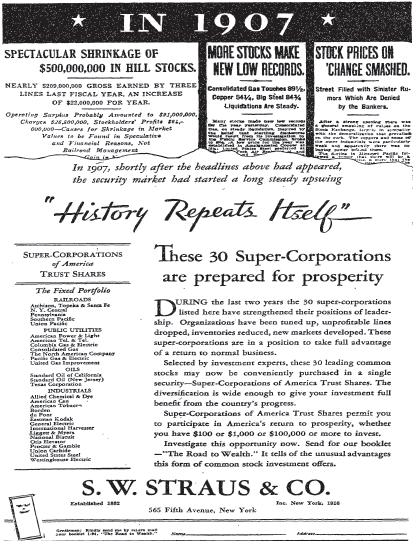
Gain of 0.8% (5,975 cars) in rail freight loadings was smaller than most authorities had expected, and well short of the usual seasonal increase; decline of 34.2% vs. same week in 1929 was the largest this year. Yet another editorial on the rail situation. Regrettable that so little of the general public realizes broad implications of rail emergency, particularly drastic decline in rail securities; “investors have long been taught to regard railroad obligations as a stable and substantial division of the investment field. The railroads are and long have been a highly regulated industry; if their profits were to be limited their well-being was at the same time to be protected ... since they render a service indispensable in the public interest.” ICC hearings on the rate increase have taken a disturbing turn, “their outward appearance has assumed the aspect of a popular referendum, with the preponderance of articulate opinion against the proposed advance.”

Economic news and individual company reports:

Weekly steel reviews again disappointing; as The Iron Age somewhat poetically put it, "with autumn close at hand, hopes of seasonal recovery ... are waning." Neither production or demand points to an uptrend; "specifications, instead of improving, are barely holding their own." Most lines are weak; automotive output still declining; improvement in rail demand apparently awaits results of the rate increase case; agricultural machinery clouded by "abnormally low level" of farm product prices; in "miscellaneous industrial" category, many "plant vacations" will last until after Labor Day. Main support for demand is from construction, much of it public works. Some reports of renewed price "shading" (discounting) by producers. Steel production for week ended Monday was 31% vs. a little under 32% previous week, 33% two weeks ago, 57% in 1930, and 87% in 1929.

France is suffering a strange combination of falling wholesale prices but "gold inflation" in retail prices; thanks to influx of gold, circulation is about 80B francs vs. 72B a year ago; wholesale price index down to 111 from 127 (due mostly to imports), while retail prices are higher.

Reichsbank end-of-month statement considered highly satisfactory; feared end-of-month money squeeze didn't develop; “exceptional period incidental to the closing of the banks” ended; mark believed out of danger.

Swedish market again saw liquidation in Kreuger stocks Tuesday, coming mostly from London; this wiped out earlier gains after Ivar Kreuger's optimistic statement. Ecuador Senate rescinds match monopoly granted to subsidiary of Swedish Match.

30% cash dividend authorized to Bank of US depositors and creditors; affidavit by Supt. Broderick says payment won't affect reorganization plan of a group of bankers headed by Gen. Lincoln C. Andrews. Bay City Bank, Michigan, failed to open; deposits over $6M.

State of Pernambuco, Brazil defaulted on bond interest due Sept. 1. Brazil limits power of state and city govts., prohibiting new taxes and bond issues.

Lehigh Valley RR suspended common dividend; will affect Pennsylvania RR and Wabash Rwy. due to their large holdings of Lehigh stock.

Texas Railroad Commission reportedly will stick to its order setting East Texas allowable production at 340,000 barrels/day, in spite of Gov. Sterling's strong desire for lower figure; Gov. Sterling previously ordered martial law maintained over the oil fields, and "direct conflict" looms between two branches of state govt.

Treasury announced it expected oversubscription for $800M offering of 20 - 24 year 3% bonds, and that its $300M one-year 1 1/4% offering is already heavily oversubscribed. New bond financing (non-US govt.) in August continued sharp decline seen in July; total of $99.6M offered in this area was lowest for any month since Aug. 1928. Seasonal apathy and the unsettled foreign situation combined to reduce all categories but municipal borrowing. Bond offerings in first 8 months (including all categories but US govts.) were $2.812B vs. $4.002B in 1930.

Fed. Reserve monthly review noted unusual demands in money market during August, thanks to “unseasonal demand for currency” and foreign fund movements. Banks largely exhausted their excess reserves in satisfying these demands. However, thanks to increased use of Fed. Reserve credit, supply of funds was ample and money rates practically unchanged.

Private estimate of US spring wheat crop was a record low of 115M bushels, while estimates for Canadian spring wheat rose somewhat.

Amer. Tariff League reports volume index of imports in July was 99, up from 95 in June and 91 in July 1930 [note: seems a bit fishy to me ... ]

Auto accessory business off sharply from Q2, though only a little below 1930 level.

The amusement industry is enjoying its usual seasonal improvement in attendance that accompanies start of the new season's films. "The low point in quality of film releases is apparently reached in mid-summer," and this affects attendance more than the weather. Industry feels outlook is "as bright as can be expected in view of general conditions"; box office will probably be slightly down from 1930 for rest of the year, but this may be offset by expense cuts at all the major cos.

US Gypsum denies FTC complaint it is misleading the public by using trade names such as "sheetrock" and "rocklath" to describe its materials.

Companies reporting decent earnings: American Home Products, Sherwin-Williams.

Theatre:

Friendship - Written by, produced by, and starring George M. Cohan, at the Fulton Theatre. Review is more than a little confusing. One theme of the play seems to be sympathy for everyone, even the character who would normally be the villain. "The play is full of the leisurely and wisely pointed naturalism of detail which has helped make Mr. Cohan famous." Louise Dale, former nightclub employee, is the mistress of Joe Townsend (Cohan) when the play opens. She "not only turns literary, but falls in love" with young writer Cecil Steinert, only to run into complications due to strict attitude of Cecil's family. Happy ending ensues as Mr. Townsend and Louise return to each other and plan to marry. Play features Broadway debut of Mr. Cohan's youngest daughter, Helen Frances.

September 2, 2010

Wednesday, September 2, 1931: Dow 140.13 +0.72 (0.5%)


Assorted historical stuff:

F. Jones, director general of the US Employment Service, resigned. Labor Sec. Doak says resignation "demanded for the good of the service"; Jones sent letter to Doak saying the newly reorganized service was ineffective, unsatisfactory and bitterly disappointing, and that Doak's request for his resignation was a compliment.

Editorial by T. Woodlock on the subject of doles - not the conventional kind, but those given to various groups including farmers (through price supports and reduced rail rates), buses and trucks (don't pay their share of highway costs) and inland waterways. “Nowadays not only does no one feel any delicacy about 'going on the nation' but there is a positive rush in that direction. It seems as if everybody considered his troubles to be everybody else's business, and more particularly the business of the National Government. Has something happened to our national morale? Did we ever have a national morale, and if we did, what has hit it?”

Editorial on resilience of farm communities; "a denizen of Wall Street who should visit ... the Middle West now, expecting to find the gloom of drought, insect pests and low prices ... would be agreeably surprised ... He would find discouragement enough, but seldom or never despair. On the contrary, he could not but be struck by the quiet determination ... to carry on and the unspoken but obvious confidence that the outcome, some how and some time, will be good."

The Hague Court postponed its opinion on legality of the "Anschluss" (Austro-Germany customs union) until Saturday. Reports in Vienna say Austria will be rewarded for abandoning the union with a new loan. France, foremost opponent of the union, was instrumental in getting the League of Nations to request the opinion from the Court. Annual League of Nations assembly is to begin Sept. 7.

Washington report: Administration seen postponing decision on tax increases for two or three months, until business trend becomes clearer. However, govt. won't "delay any measures that may be necessary to maintain the confidence of the country in the stability of the government's finances." National City Bank, among others, has advised taking action on reparations relief to end uncertainty and remove a bar to world recovery. However, the Administration continues to officially deny contemplating such action, possibly influenced by position of France and by political opinion in the US. Also, the Administration's position against Federal relief spending might be difficult to defend if foreign debts are being scaled down. Administration position on relief misunderstood; not opposed to any taxation for relief, but believes it's more properly a local function rather than one for "a government in Washington hundreds of miles from the scene." US loan to Great Britain involves "delicate political problem"; the London Herald printed a charge that the British govt. had been forced to cut the dole in exchange for the loan. Despite prompt denials on both sides of the Atlantic, "it is proving a somewhat difficult job to make the denial stick, as far as some Britons are concerned."

Labor Sec. Doak says coal operators overwhelmingly oppose calling of national conference to discuss industry problems as requested by John L. Lewis of the United Mine Workers. Doak says attitude of operators has ended plans for conference at this time, doesn't know what next move will be.

W. Gifford, dir. of the President's unemployment relief organization, has named Owen D. Young chair. of committee to coordinate collection of funds.

Coincident with the mass movement against racketeering, Chicago is now also to be the initial site of the battle against the health menace of the common house fly. "Statistics reveal that a toll of no less than 75,000 persons, mostly children, is exacted yearly through the 30 diseases carried" by the fly. Swatting believed ineffective; "war is to be waged with chemical sprays ..."

Yet another editorial on the Eskimos' prosperity; indulgence in luxuries, "particularly white man's food such as canned goods, chocolate and cakes," has lowered resistance to disease, and influenza epidemics frequently take a heavy toll. Establishment of reindeer herds believed to offer "salvation of the Eskimo," supplying excellent meat and hide; "3,000 reindeer are being imported from Alaska, and Scandinavian families brought from Lapland to train the Eskimos in herding."

Editorial blasting George Bernard Shaw for offenses not fully specified. "Compare his technique with that of our own Mr. Mencken and see the difference between a real professional and a fairly good amateur. It is, perhaps, only fair to say that Mr. Mencken is handicapped by the possession of a conscience - warped, no doubt, but still live enough ... while Mr. Shaw suffers from no such disability ..."

NYSE volume Tuesday was 500,000 shares, the smallest 5-hour (full day) session since Oct. 1924. Tuesday's total also was only nine minutes worth of trading on the record-setting day of Oct. 29, 1929, when 16.410M shares traded. [Note: That day was later known as Black Tuesday; the volume record set then stood until 1968] .

Market commentary:

Market wrap: Stock trading "practically ... featureless," with most stocks moving within narrow limits; most trading was professional, "representing the efforts of the ... operators to scalp small profits on either side." Public participation was at a minimum, and brokers continued to complain of a lack of orders on either side; volume was around the lowest levels since start of the Coolidge bull market 7 years ago. Bonds generally higher in more active market. Domestic corp. issues strong, with the Dow 40-bond average rising for the 6th consecutive day. Second-grade rails continued to advance, only temporarily unsettled by default of the Florida East Coast Rwy. US govts. fairly active and slightly higher. German bonds lower; Italian firm on success of economic program. S. American mostly lower; some Brazilian issues hit record lows. Grains moved higher, with particular strength in Sept. futures. Copper remained at 7 1/2 - 7 3/4 cents with buying quiet. However, current overproduction is estimated at 40M pounds/month; together with already large inventories, situation is seen leading to drastic curtailment or further price declines.

Conservative observers continue recommending sidelines, believe "market could break out of its rut on either side on any new incentive."

"With the outstanding bull leader departing for the air races in Cleveland, and the principal bear absent on an extensive tour," traders were left without aggressive leadership; Wall Street appeared resigned to the prospect of "little action ... until after Labor Day," when "tradition calls for the market to assume definite form." Stocks continued to resist declines, with selling drying up on reactions. Sentiment improved on firmer tone in grain markets and better feeling regarding foreign conditions.

Rail earnings over the next 8 weeks will be watched closely. Normally the rails show increasing earnings from the beginning of July to mid-Oct.; this year has proved disappointing so far, though there's still time for some gains to be shown in Sept. - Oct.

Current market favorites include Woolworth, J.C. Penney, and Coca-Cola; they have shown higher earnings this year.

North Amer. Light & Power has plunged 18 points since Saturday's close, to 48; co. controlled by Middle West Utilities along with Clement Studebaker, Jr.

Weakness in commodity prices seen as increasingly important stock market factor due to effect on buying power and conditions in agricultural districts.

"Comments heard in the financial district indicate conclusively that opinions on the business outlook are mixed." However, some still hope for fall improvement in conditions, while admitting it may be below the usual seasonal increase and may not last through the winter.

Baar, Cohen & Co. see stocks clearly in a period of accumulation [note: that's the good one.] "On all reactions we find the buying to be of infinitely better character than the selling but there is no disposition to follow up the rallies." Picture "clearer than in many months"; forces worldwide "working for order, stabilization and intelligent financing ... foreign countries putting their house in order. We are entering an era of economic sanity and of fair administration of national finances ..."

Economic news and individual company reports:

Ohio Att'y. Gen. G. Bettman arrived in Toledo; will, together with "practically his entire staff," take personal charge of investigation of the bank closings there. Bettman will reportedly investigate for Gov. White the "many rumors that one or more directors of the closed institutions withdrew large deposits and obtained large loans shortly before they closed their doors." Assets of the Security-Home Trust Co. will be less than expected due to holdings of German bonds and common stocks. Two more small banks in the Toledo area closed over the weekend. NY Supreme Court Justice Carew will probably decide this week on NY Banking Supt. Broderick's application to declare a dividend of 30% of assets of the Bank of US. A protest was filed by Bank of US Depositors' and Stockholders' Assoc., stating such action would endanger its plan of reorganization.

Fairman R. Dick, testifying before the ICC in favor of the 15% rail rate increase, says rail credit situation has become more serious due to declines in bond prices "which have extended into bonds formerly beyond question. These rails have been the favorite medium for investment of secondary reserves" at banks.

Florida East Coast Rwy. defaulted on interest on $45M in bonds, and was placed into receivership.

Reichsbank cut discount rate to 8% from 10%; measure seen as preparation for reopening of stock exchange Thursday. Reichsbank position believed satisfactory considering earlier strain; reserve ratio steadily climbing; gold reserves kept intact since mid-July; no evidence of "hoarding of currency." When stock exchange does reopen, it "will be under the strictest supervision, since artificial support will not be possible; quotations may be suspended at any time when trading gets out of hand."

Huge Australian internal bond conversion [to lower rate, voluntarily] apparently successful; large majority agrees to convert, though final figures not yet available.

Stocks in Switzerland suffered a spectacular slump Friday; large Swiss banks have formed a "consortium" to support prices. Swiss francs remained firm against other currencies. Stocks in Paris slumped due to selling from Switzerland and "various adverse rumors." Sterling is showing slow improvement against francs, though there have been no support operations since Monday.

Texas Gov. Sterling was dissatisfied with the proposed order of the Texas Railroad Commission setting East Texas production at 340,000 barrels/day. He immediately ordered Gen. J. Wolters that no well in the field was to be allowed to reopen until further instructions, and held a "private consultation" with the commission; the commission "set about redrafting its order."

Rail freight loadings for week ended Aug. 22 were 748,711, up 5,975 from prev. week, down 20.3% from 1930 week, and down 34.2% from 1929.

Youngstown sheet and tin mill workers agree to wage cut of 3% for two months.

Hog prices at Chicago hit a new yearly low of $5.61 per 100 lb., vs. $5.81 in prev. week and $10.03 a year ago.

Chevrolet output of cars and trucks in Aug. was 54,958 vs. 51,622 in Aug. 1930; fourth consecutive month to show increase over 1930.

Pure Oil Co. has begun selling a new discount "third-grade" gasoline, colored blue; its regular-priced Purol-Pep gasoline, formerly colored blue, "has been changed to a golden color."

Remington Rand sees encouraging response to introduction of new "noiseless portable" typewriter; the company's 2,000 sales representatives demonstrated it in 50,000 offices during a single day last week. "These demonstrations revealed that preparations are being made for an early resumption of normal business conditions, and that sentiment was particularly optimistic in the shoe, hat and textile lines."

September 1, 2010

Tuesday, September 1, 1931: Dow 139.41 -2.67 (1.9%)


Assorted historical stuff:

A plan to aid real estate by "forming a corporation to finance and hold off the market for a time forclosed real estate properties" has reportedly been discussed in Washington. Both government officials and private financiers have shown interest, but no decision has yet been reached. However, any action taken will probably be by private initiative, "although Washington may indicate its approval and support. ... The feeling in well-informed quarters here is that the real state situation is one of the most disturbing factors in the present depression"; the proposed corporation could "act as a stabilizing influence, and ... in the long run it probably would conduct its operations at a profit ..."

US medical stats: 825,000 hospital beds, with operating costs of $1,500/year each, making total of $1.238B/year in hospital costs. 157,000 doctors, with average income $4,000, for total about $600M; total nurses income $300M; total cost of drugs and supplies $700M; total of the above $2.838B.

The international petroleum trade has grown remarkably since 1921. The world's largest oil producer, the US, is also the world's largest exporter of gasoline, at 63.2M barrels in 1930 vs. 6.5M in 1921 (the US also imported 16.9M); however, the US share of world gasoline exports has dropped to 49% from 72% in 1924. The US also leads in exports of other refined oil products. The largest gasoline importers are Britain (27.3M), France and Germany. Venezuela is the largest exporter of crude oil. US imports of crude oil in 1930 were only 62M barrels, a small percentage of domestic output and consumption (US oil production was running at about 2.5M barrels/day until recent shutdowns).

8,765 enlisted men deserted from the U.S. Army in 1929 or 4.59% of the total. This is a substantial decline from five years previously, when deserters numbered 13,760, or 7.39%. Largest cause of death in the Army in peacetime is suicide.

Underwood Elliott Fisher has introduced a "universal bookkeeping machine, capable of totalizing up to 30 vertical columns and up to seven cross computations."

"Gypsies, noted for centuries as horse thieves and originators of crooning love lyrics, are now being 'collectivized' in Soviet Russia." There are now several hundred at a collective farm in the North Caucasus; "they seem content."

J. Mannix, NY City Municipal Lodging House superintendent, says the House faces problem of providing 3M meals and 800,000 lodgings this winter. "Police prepare to check invasion of NY by unemployed from other cities."

Twelve leading US publishers say US book industry showing strong recovery from depression, see prospects for best fall season since start of hard times. Note greater public taste for serious books.

David T. Abercrombie, originator of firm of Abercrombie & Fitch, dead at 64. [Note: I always thought that was a made-up name.]

Interesting reminisce by H. Alloway concerning cost of building the NY subway. The initial construction cost $2M a mile; this has now ballooned to the astronomical sum of $14M. The Holland Tunnel was initially estimated to cost $15M; eventual cost was $47M.

Market commentary:

Market wrap: Stocks experienced good-sized setbacks in early trading after unexpected announcement of $1.1B Treasury offering; weakness attributed to prospect of higher taxes. Trading turned dull after early declines, but market worked lower in sluggish fashion for rest of the session. Dull bond trading featured firming in US govts. Rail issues continued improvement, particularly second-grade. Public utilities firm. S. American list disturbed by sharp break in Brazilian bonds after announcement of partial moratorium. British and German issues slightly lower. Wheat fell sharply to new season lows; Sept. wheat, at the day's low of 45 cents/bushel, set another record low for CBOT futures, though in 1852 cash wheat sold as low as 28 cents. Cotton down sharply. Copper remained at 7 1/2 - 7 3/4 cents with buying dull.

Some short sellers have begun to target tobacco stocks, which have held up relatively well so far in the bear market, based on decline in cigarette consumption and possible increased taxation.

Sears Roebuck and Montgomery Ward fell after abandonment of merger negotiations. Westinghouse was pressured on news dividends may be cut further. Lambert has drawn "quiet buying" on satisfactory earnings so far this year.

Trading remains largely professional; "some traders are satisfied at attempts to make the old-fashioned eighths, which they had considered as a thing of the past."

NYSE volume for August totaled 24.829M shares, an average of 954,943 shares a day; this was the lowest volume for August since 1924 (22.256M).

While last week brought some comforting developments in the foreign situation, "Wall Street still feels that conditions are far from settled in many countries, and that the best that can be looked for is a slow, laborious recovery over a long period, with more anxious moments from time to time." Britain and Germany still have a tough row to hoe, and smaller countries still face banking problems. "An opinion has crystallized" that, as the US suffered the first shock of the economic crisis in the stock market crash, it will also be first to show definite recovery. Many believe that due to the British situation, "the Old Lady of Threadneedle Street definitely has yielded her position as leader in finance to this country."

"One leading banker said that one of the best signs since the panic burst over us in 1929 is the fact that people in the US have entirely lost their complacent attitude toward the future. He said that most of economists, financiers and industrial leaders as well as the people at large spent much of their time and talk in 1929, 1930 and the early part of 1931 predicting just when things were going to turn for the better. First it was going to be in the spring of 1930, then the fall and later the spring of 1931. Now all concerned realize that times are really bad and have ceased predicting and are striving to improve matters both here and abroad."

J. Kurn, St. Louis - San Francisco Rwy. pres.: "Business is still poor, but we feel there is bound to be an improvement soon. The Southwest and Southeast have the greatest crops in history. Unfortunately they are not bringing good prices and are not moving. Practically all farmers are stacking their wheat."

Economic news and individual company reports:

Farm Board acting chair. Williams says the Board isn't considering purchase of cotton due to continued overproduction. Believes situation will improve without further aid as working of economic law will inevitably reduce cotton acreage next year. Louisiana Gov. Long's plan for one-year cotton holiday is running into some resistance; doubts are arising on its effectiveness if implemented, since world cotton producers would probably increase production in response; Oklahoma Gov. Murray opposes plan and won't call special session to consider it; Texas Gov. Sterling will probably call session to consider the plan but passage in Legislature is doubtful. Southern senators propose a rather complex cotton relief plan in which the Board would "sell" its cotton holdings to farmers, with no money changing hands, in return for acreage reductions. When the cotton is sold next year, presumably at a higher price due to the acreage cuts, the farmer would pocket the difference. Farm Board officials declined to express opinion on the plan. Another proposed plan by the Texas Bankers' Assoc. has been abandoned.

Guaranty Trust survey reports business activity remains at very low levels except for small seasonal gains in some lines; Guaranty index reached new low level of 68.3 last month vs. 69.3 in June and 83.9 a year ago. “Nevertheless, a number of favorable conditions support the belief that some expansion is likely to occur in the near future.” While commodity prices haven't maintained the strength shown last month, recent behavior still indicates “influences making for price recession have spent most of their force.” Retail volume has apparently increased, though dollar value of sales is down due to lower prices. Some consumer goods industries continue to recover, including textiles and shoes; this improvement may gradually work its way back into more basic industries. However, “enough obstacles remain to convince most observers that the return to prosperity, in this country as well as elsewhere, will be a slow and highly irregular process.”

Long-rumored merger between Sears, Roebuck and Montgomery Ward falls through as negotiations are terminated; main stumbling block believed to be valuation of Ward assets due to lack of earning power over past two years.

Monsanto reports interesting result of experiment in going against prevalent trend of wage cuts. In Q2 of 1931, the company increased hourly wages by an average of 10.4% over that paid in Q2 1929; instead of increasing, labor cost per unit of ouput fell 15.5%.

Labor Dept. reports "many manufacturing establishments in July continued on curtailed operating schedules and a large number of workers were employed part time." Labor Dept. says 103,000 children between ages of 14 and 15 were granted permits to drop studies last fiscal year, to take jobs which might have been available for older persons.

Martial-law shutdown of East Texas oil production estimated to have reduced rail freight loadings by 7,100 cars in past week. Number of new wells completed in East Texas area fell to 0 from 66 in previous week.

R.L. Polk & Co. reports retail passenger car sales for July were 194, 388, down 3.7% from June and 23.5% from July 1930; first 7 months 1.372M, down 28.1% from 1930 and 33.2% from the five year average. Commerce Dept. reports July passenger car production in the US and Canada totaled 186,078 units, vs. 214,538 in June and 230,385 in July 1930; first 7 months 1.554M vs. 2.184M.

Brazil announced a debt moratorium over the weekend, but clarified it applies only to "sinking fund" and not interest payments (sinking fund payments reduce the principal owed). Plan obviously designed to relieve pressure on currency; will save about $20M annually. Fin. Min. Whitaker says govt. expects to maintain interest payments without difficulty.

Companies reporting decent earnings: Diamond Match [Kreuger-associated], Brooklyn-Manhattan Transit.

Movie:

The Dreyfus Case - British film version of the play by Herzog and Rehfisch. [Note: I believe this is a filmed version of the German play that was reportedly banned in France (see Apr. 17, 1931).] Film features fine performances, and the episodes involved in the case are well-portrayed. "Despite the excellence of the film as a whole, however, it has its weaknesses. In the first place, the anti-Semitic nature of much of the persecution of Dreyfus seems to be soft-pedaled." Also, the ending makes Dreyfus' exoneration following his pardon seem more automatic than it was in life.

Joke:

Lawyer - We need to establish an alibi. Did anyone see you at the time of the crime? Client - Fortunately, no.
